


CALL: 075 275 78428
Sun Trip
Inventors, adventurers, tinkerers, futurists
A solar-powered adventure a brief history of the Sun Trip
History of the Sun Trip solar-powered E-bike adventures by (boden Ryan, founder) Shawn Ryan
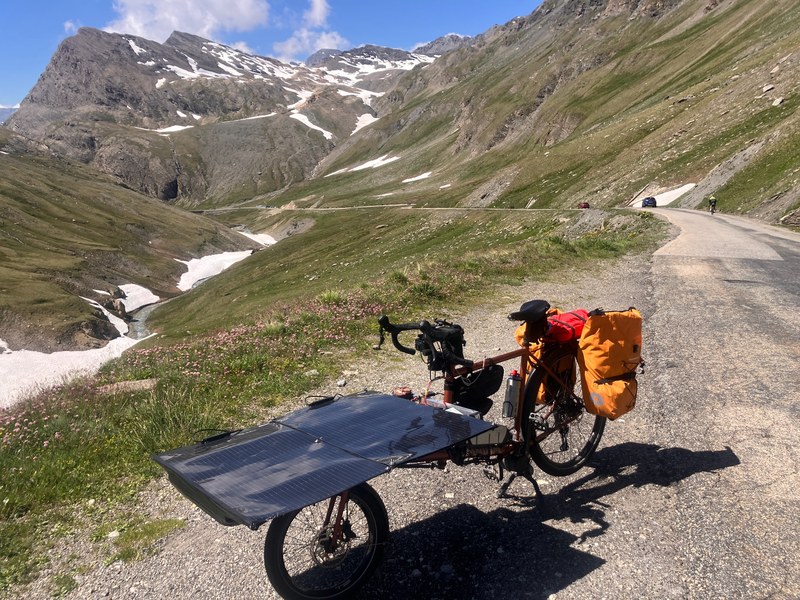
This year I took part in the 2026 Sun Trip using my Omnium cargo bike with a solar panel mounted on the front. I am not going to go into detail about my experience here; that will be in the next article, where I will talk about my bike and setup, how I fared, and my thoughts on how an average man like myself can take on the Sun Trip.
Whats it all about
When explaining to my friends, I use the analogy of the first Peking to Paris automobile race in 1907. Inventors, adventurers, tinkerers, futurists, a collection of people pushing the envelope of transportation, looking insane and having fun. Will solar transportation be the norm? In 1907 people were sceptical about the new motorised horses. EVs are now outselling combustion vehicles. There are projects such as the Africa electric motorbikes that are built locally and powered by solar, using modular batteries with solar panels mounted on shipping containers as the charging hubs. Recently, car manufacturer Solarky have produced the SunV car, an electric car with its own solar roof and a range of 150km.
Maybe not here in the cloudy UK, but the world is warming, and solar technology is advancing at a tremendous rate.
,
Florian, the founder of the Sun Trip, really believes so.
The Sun Trip is an international series of long-distance events for electric bicycles powered primarily by onboard photovoltaic panels or solar panels. Founded in France in 2013 by adventurer Florian Bailly, the event combines endurance cycling, engineering innovation and the promotion of renewable energy and sustainable transport.
Participants ride electrically assisted bicycles that generate their own electrical energy using solar panels mounted on the bicycle or an accompanying trailer.
[1]Unlike conventional cycle races, The Sun Trip is largely self-supported. Riders are responsible for navigation, accommodation, repairs and energy management throughout the event.
Depending on the edition, participants either choose their own routes between compulsory checkpoints or follow an organised itinerary through designated regions.[2]
Since its creation, The Sun Trip has organised expeditions across Europe, Central Asia, China and North Africa, together with shorter regional events in France and the Alps.
The Sun Trippers ' combination of human power and electric assistance has attracted international media attention as a demonstration of practical solar-powered transport and experimental bicycle engineering.[3]
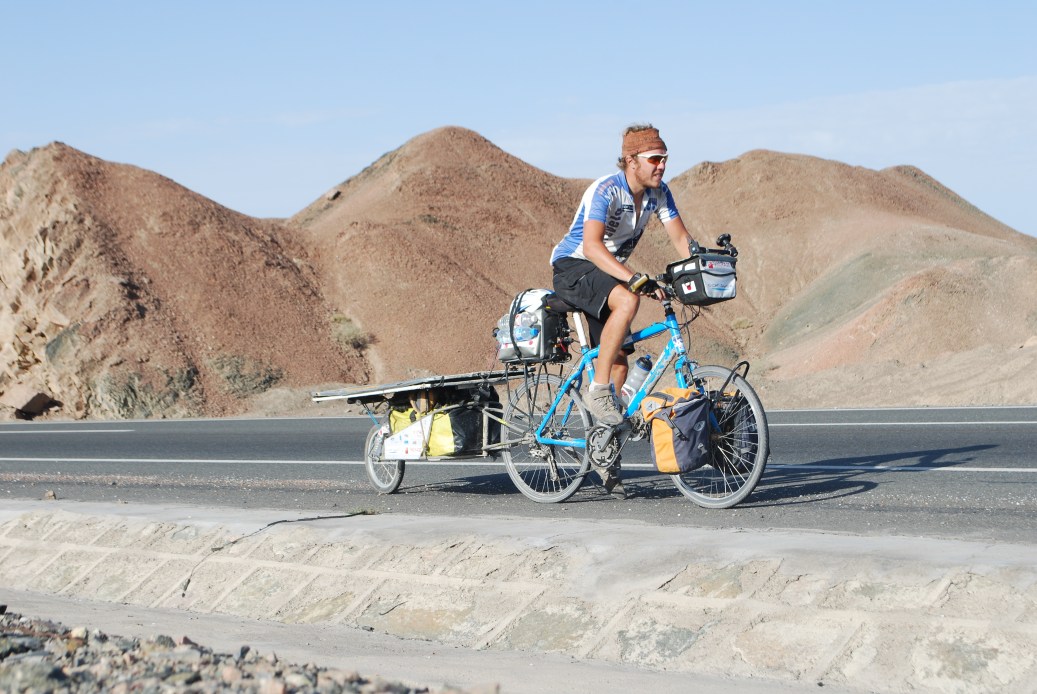
In the photo: Florian Bailly riding his solo expedition from France to Japan in 2010 using a solar-powered electric bicycle. (Photo: Sun Trip)
History Origins
[4]History Origins: The origins of The Sun Trip lie in Florian Bailly's solo expedition from France to Japan in 2010 using a solar-powered electric bicycle. Bailly departed from the French National Institute of Solar Energy (INES) at Le Bourget-du-Lac and travelled across Europe and Asia before reaching Japan several months later.
The expedition was conceived as a demonstration of the potential to combine human power, electric assistance and solar energy over intercontinental distances.[5]
The journey received coverage in French and international media. It inspired Bailly to establish an organised event in which multiple riders could undertake similar expeditions using their own solar-powered bicycles.[6]Following his return, Bailly founded the Association The Sun Trip.
The organisation was established to promote renewable energy, sustainable mobility and technical innovation through long-distance cycling expeditions.[7]
History of the Sun Trip solar-powered E-bike adventures by Shawn Ryan
Sun Trip editions
2013: France–Kazakhstan.
The first Sun Trip began in June 2013 from Savoie, France, and finished in Astana, Kazakhstan. Twenty-eight participants representing several European countries set out on a journey of more than 8,000 kilometres across Europe and Central Asia.
Unlike traditional stage races, riders were free to choose much of their own route provided they passed through compulsory checkpoints established by the organisers.
Participants were also responsible for organising accommodation, maintenance and charging strategy throughout the event.[8]The event attracted a diverse range of vehicles, including upright touring bicycles fitted with lightweight photovoltaic panels, recumbent bicycles, recumbent tricycles and custom-built experimental machines.
The variety of engineering approaches became one of the defining characteristics of The Sun Trip, distinguishing it from conventional electric bicycle competitions.[9]Belgian rider Raf Van Hulle became the first participant to reach Astana after 37 days.
Eleven competitors completed the journey while remaining eligible for the Solar Challenge classification, which required batteries to be recharged exclusively from solar energy throughout the expedition.
[10]Coverage of the inaugural edition focused not only on the sporting achievement but also on the demonstration that lightweight solar-powered vehicles could complete an intercontinental journey under everyday conditions.
The event also formed part of wider promotion for Astana's successful bid to host Expo 2017, whose theme was "Future Energy".[11]
2015: Italy–Turkey–Italy
Organisers originally intended to stage another expedition towards Kazakhstan.
However, political instability associated with the conflict in eastern Ukraine resulted in a redesigned route.
The 2015 Sun Trip instead followed a circular course beginning in Milan, travelling through Italy and Turkey before returning to Italy. The revised route covered approximately 7,000 kilometres while preserving the event's philosophy of rider autonomy and solar-powered travel.[12]French cyclist Bernard Cauquil recorded the fastest overall performance.
Compared with the inaugural edition, participants benefited from improvements in lithium-ion battery technology, photovoltaic efficiency and electric bicycle design, allowing significantly greater daily distances to be achieved. By the conclusion of the 2015 edition, The Sun Trip had established itself as the world's best-known recurring event dedicated specifically to long-distance solar-powered electric bicycles.
The event had also begun to attract engineers, renewable-energy specialists and amateur constructors interested in testing prototype vehicle designs under real-world conditions.[13]
Development Sun Trip Tour (2017)
Following two intercontinental editions, the organisers introduced the Sun Trip Tour in 2017.
The new format was intended to make solar-powered cycle touring accessible to a wider range of participants while maintaining the principles of self-sufficiency and solar-powered travel.
Rather than a single expedition across Eurasia, the inaugural Tour followed a route of approximately 1,000 kilometres through the Auvergne-Rhône-Alpes region, Switzerland and northern Italy. Around 45 participants took part using a wide variety of solar-powered bicycles, recumbents and tricycles.
The event placed greater emphasis on public engagement than previous editions. Daily arrivals were organised in partnership with local authorities and included exhibitions, technical presentations and meetings with schools and members of the public.
Riders continued to travel independently between official meeting points, allowing different route choices while remaining part of the same event.[14]The introduction of the Tour format marked a shift in the organisation's activities, allowing annual regional events alongside the larger intercontinental expeditions.
France–China (2018): The third major expedition departed from Lyon in June 2018 with the destination of Guangzhou, China.
The route covered approximately 12,000 kilometres across Europe and Asia, making it the longest Sun Trip organised to that date.[15]Thirty-six participants travelled through Eastern Europe, Russia, Kazakhstan and western China before reaching Guangzhou.
The expedition commemorated the thirtieth anniversary of the twinning relationship between Lyon and Guangzhou.
Belgian cyclist Raf Van Hulle became the first rider to reach Guangzhou, completing the journey after approximately seven weeks and averaging around 270 kilometres per day during the expedition.[16]
Raf Van Hulle and his solar bike highlighted the increasingly sophisticated engineering of the competing bicycles.
Compared with earlier editions, participants used lighter photovoltaic modules, larger battery capacities and more aerodynamic vehicles, enabling substantially longer daily distances.[17]
Sun Trip Tour (2019): The regional Tour format returned in 2019 with an expanded field of more than fifty participants.
The event travelled through central and south-eastern France, once again combining long-distance cycling with public demonstrations of solar-powered transport.
The growing variety of bicycles, including upright touring bicycles, recumbents, tricycles and fully custom-built vehicles—reflected the rapid technical development of solar cycling since the inaugural event in 2013.[18]By this stage, The Sun Trip had developed into both an endurance challenge and a meeting point for engineers, enthusiasts and renewable-energy advocates interested in lightweight solar-powered transport.
Sun Trip France (2020): Organisers planned a second France-to-China expedition during 2020. The project was cancelled following the global COVID-19 pandemic and the resulting international travel restrictions. In its place, the Association organised Sun Trip France, a multi-stage journey within France that allowed participants to continue testing solar-powered bicycles under long-distance touring conditions while remaining within domestic travel regulations.[19]
The revised event preserved the core philosophy of self-supported solar-powered travel despite the exceptional circumstances.
Sun Trip Europe (2021): The international format returned in 2021 with Sun Trip Europe, beginning in Brussels before crossing much of continental Europe and finishing in Lyon.
The principal route covered approximately 10,000 kilometres through as many as thirty European countries. Participants again travelled independently while following a common overall itinerary.[20]
The edition received support from the European Commission, which presented the project as an example of sustainable and inclusive mobility.
The event also encouraged participation by riders using adapted cycles and promoted cycling as a practical form of low-carbon transport.[21]
Regional development: Following the success of Sun Trip Europe, the organisation increasingly alternated between major international expeditions and shorter regional events.
The Sun Trip Alpes editions of 2022 and 2023 explored the Alpine regions of France, Switzerland, Italy, Austria and Slovenia.
These editions focused on mountainous terrain, placing greater emphasis on climbing efficiency, solar energy management and vehicle reliability than the predominantly flat transcontinental routes.[22]
In 2024, organisers launched Sun Trip Destination Sahara, extending the concept to North Africa with a route between France and Morocco.
The 2026 edition returned to the Auvergne–Rhône-Alpes region, crossing major Alpine passes including the Col du Galibier and the Col de l'Iseran before finishing in Albertville.[23]
Proposed 2028 edition Plans: A new Lyon–Guangzhou edition in 2028 was reported by specialist cycling publications in December 2025.[24][25] The project was formally presented during the departure of the 2026 Sun Trip Auvergne-Rhône-Alpes, held on 22 June at the headquarters of the Regional Council of Auvergne-Rhône-Alpes in Lyon.
[26]The provisional journey would cover approximately 15,000 kilometres (9,300 mi) through the Balkans, Turkey, the Caucasus, Central Asia and western China, avoiding Russia and crossing the Caspian Sea. Around 40 participants are expected to be selected, with the route and regulations remaining subject to change.[27]
And so we have the brief history of the Sun Trip. There's probably lots of things I have missed, but hopefully you get the idea and want to find out more.
Check out the Sun Trip website
Notable participants
Notable participants have included: Florian Bailly – founder of The Sun Trip and organiser of the 2010 France–Japan solar bicycle expedition.Raf Van Hulle – Belgian cyclist and winner of the 2013 France–Kazakhstan and 2018 France–China expeditions.Bernard Cauquil – French cyclist and winner of the 2015 Italy–Turkey–Italy edition.Jack Butler – British cyclist and winner of the 2024 Destination Sahara edition.[41]See alsoElectric bicycleBicycle touringUltra-distance cyclingSolar vehiclePhotovoltaicsRenewable energySustainable transportHuman-powered transportExternal linksOfficial website↑ "The Concept". The Sun Trip. Retrieved 14 July 2026.↑ "Rules of Adventure". The Sun Trip. Retrieved 14 July 2026.↑ "Belgian wins inaugural France-China solar bike race". Phys.org. Agence France-Presse. 4 August 2018. Retrieved 14 July 2026.↑ "Cyclists on solar-powered bikes set off on a 10,000 km tour of Europe". Euronews. 16 June 2021. Retrieved 14 July 2026.↑ "De la France au Japon en vélo solaire". La Dépêche (in French). 4 June 2010.↑ "A Solar Bike Ride From France to Japan". The Wall Street Journal. Agence France-Presse. October 2010.↑ "History". The Sun Trip. Retrieved 14 July 2026.↑ "Solar bike journey highlights sustainable energy, Expo 2017". The Astana Times. 26 June 2013. Retrieved 14 July 2026.↑ "Czech Solar Team to Race 7,300 km on Solar Electric Trikes in The Sun Trip". Electric Bike Report. 2013.↑ "History". The Sun Trip. Retrieved 14 July 2026.↑ "Solar bike journey highlights sustainable energy, Expo 2017". The Astana Times. 26 June 2013. Retrieved 14 July 2026.↑ "History". The Sun Trip. Retrieved 14 July 2026.↑ "Belgian wins inaugural France-China solar bike race". Phys.org. Agence France-Presse. 4 August 2018. Retrieved 14 July 2026.↑ "History". The Sun Trip. Retrieved 14 July 2026.↑ "Belgian wins inaugural France-China solar bike race". Phys.org. Agence France-Presse. 4 August 2018. Retrieved 14 July 2026.↑ "Solar-powered Belgian cyclist reaches Guangzhou after 45 days". China Daily. 7 August 2018. Retrieved 14 July 2026.↑ Lambert, Fred (27 September 2018). "How one rider crossed Eurasia on a solar-powered electric bicycle". Electrek. Retrieved 14 July 2026.↑ "History". The Sun Trip. Retrieved 14 July 2026.↑ "History". The Sun Trip. Retrieved 14 July 2026.↑ "Cyclists on solar-powered bikes set off on a 10,000 km tour of Europe". Euronews. 16 June 2021. Retrieved 14 July 2026.↑ "The Sun Trip project: a journey to discover Europe in an inclusive and sustainable way". European Commission. 17 June 2021. Retrieved 14 July 2026.↑ "History". The Sun Trip. Retrieved 14 July 2026.↑ "ST Auvergne-Rhône-Alpes 2026". The Sun Trip. Retrieved 14 July 2026.↑ "Le Sun Trip annonce son prochain grand départ, en 2028". Isabelle et le Vélo (in French). 12 December 2025. Retrieved 31 July 2026.↑ Bertrand, Granden (23 December 2025). "The Grand Sun Trip race is back!". Recumbent.news. Retrieved 31 July 2026.↑ "Sun Trip Auvergne-Rhône-Alpes 2026". The Sun Trip. Retrieved 31 July 2026.↑ "The Sun Trip 2028: Lyon-Canton!". The Sun Trip. 10 July 2026. Retrieved 31 July 2026.↑ "The Concept". The Sun Trip. Retrieved 14 July 2026.↑ "Rules of Adventure". The Sun Trip. Retrieved 14 July 2026.↑ "Rules of Adventure". The Sun Trip. Retrieved 14 July 2026.↑ Lambert, Fred (27 September 2018). "How one rider crossed Eurasia on a solar-powered electric bicycle". Electrek. Retrieved 14 July 2026.↑ "Introduction". Vélo Solaire. Retrieved 15 July 2026.↑ "Introduction". Vélo Solaire. Retrieved 15 July 2026.↑ [28]↑ "The Concept". The Sun Trip. Retrieved 14 July 2026.↑ "Belgian wins inaugural France-China solar bike race". Phys.org. Agence France-Presse. 4 August 2018. Retrieved 14 July 2026.↑ "Cyclists on solar-powered bikes set off on a 10,000 km tour of Europe". Euronews. 16 June 2021. Retrieved 14 July 2026.↑ Lambert, Fred (27 September 2018). "How one rider crossed Eurasia on a solar-powered electric bicycle". Electrek. Retrieved 14 July 2026.↑ "The Concept". The Sun Trip. Retrieved 14 July 2026.↑ "The Sun Trip project: a journey to discover Europe in an inclusive and sustainable way". European Commission. 17 June 2021. Retrieved 14 July 2026.↑ "Analysis ST24 Race". The Sun Trip. Retrieved 14 July 2026.


