


CALL: 075 275 78428
Who Pays When Adventure Goes Wrong?
Inventors, adventurers, tinkerers, futurists
When Does Adventure Become Excess?
Who Pays When Adventure Goes Wrong? by filmmaker, photographer and solar bike builder, Shawn Ryan
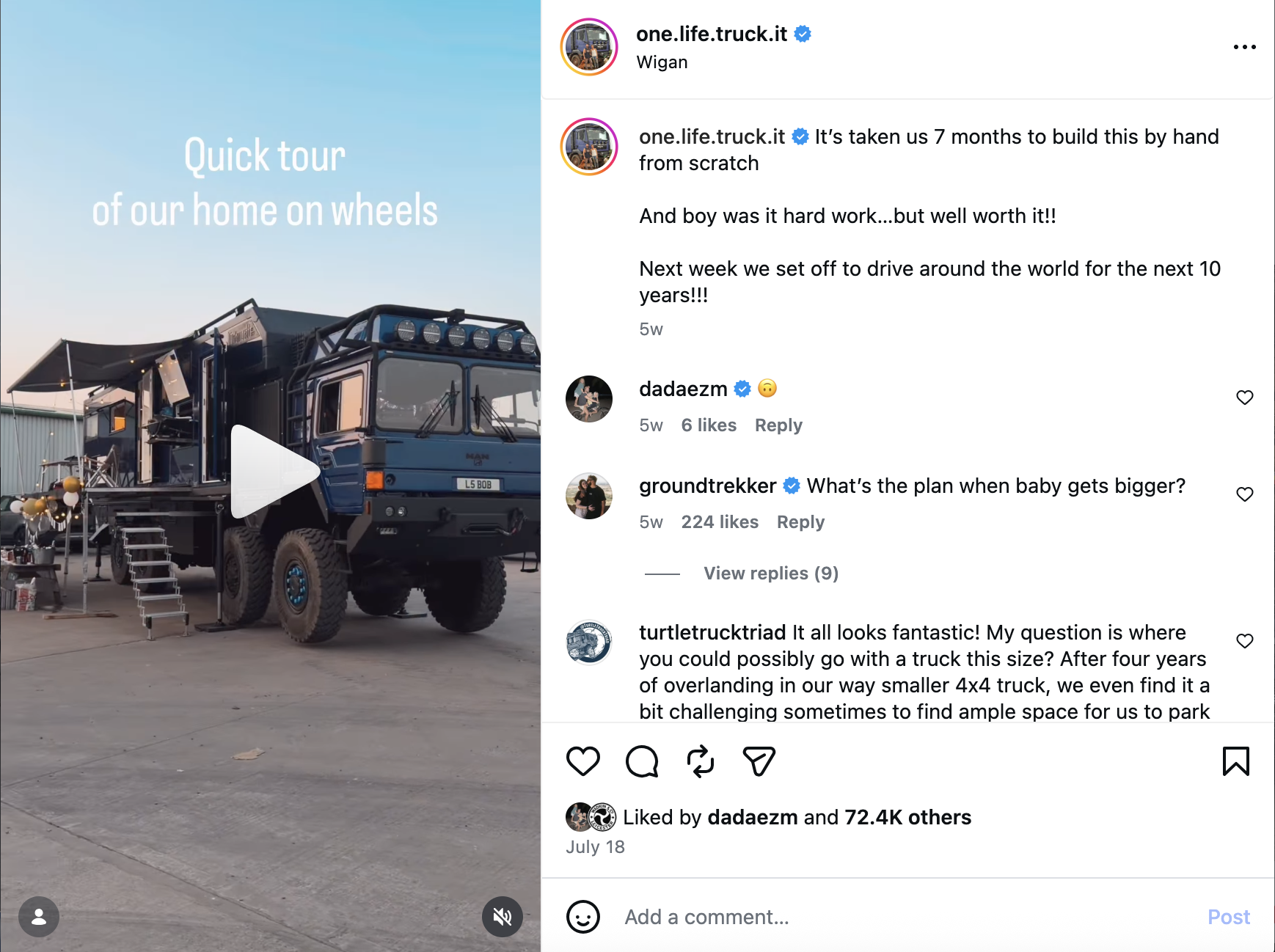
Recently, Instagram fed me a post from an overlanding family who had crashed their enormous expedition truck in Central Asia.
This wasn’t a camper van.
It was a former military MAN truck converted into a family home: a many-tonne machine built to travel across some of the most remote parts of the world.
Thankfully, nobody was seriously injured.
Shortly afterwards, a crowdfunding appeal appeared.
The family explained that comprehensive worldwide insurance for a vehicle like theirs had not been realistically available and that they had knowingly accepted the financial risk.
A considerable amount of their savings had gone into the vehicle.
Their followers were now being asked to help them recover from the loss and rebuild.
My immediate reaction was irritation.
But the more I’ve thought about it, the less interested I’ve become in whether that particular family was right or wrong. Instead, i started to think about: Does having an audience change the risks we’re prepared to take?
The invisible safety net
Setting off across Asia 70 or 80 years ago. You might have had a newspaper following your expedition. You might had a sponsor or wealthy patron.
But if you broke your vehicle thousands of miles from home, the immediate problem was fundamentally yours. You had whatever money, equipment, insurance, contacts and ingenuity you’d brought with you.
Of course, adventurers have never been completely self-reliant. Wealthy families have rescued their children for centuries.
Patrons funded explorers. Newspapers sponsored expeditions. Embassies intervened. Local people offered extraordinary generosity.
But social media has created something different. An adventurer can now carry tens or hundreds of thousands of people with them.
Those people aren’t physically present. They’re sitting on the other side of a screen. But they know the adventurer.
They’ve watched the vehicle being built. They’ve followed border crossings and breakdowns. They may know the children’s names and recognise the family dog.
They’ve spent months or years emotionally investing in the journey. Then something catastrophic happens.
Within minutes, the adventurer can tell all of them. And within minutes, those people can send money. That is an extraordinary new resource.
Does being watched change risk?
I’m not suggesting that somebody consciously thinks: I don’t need insurance because I’ve got Instagram followers.
Human behaviour is rarely that straightforward.
But knowing that a support network exists could still change how catastrophic failure feels.
If you have wealthy parents who could transfer £20,000 tomorrow, you can afford to take a financial risk that somebody without that family support might reasonably reject.
If you have a wealthy patron behind an expedition, the calculation changes again.
And perhaps having 100,000 followers creates another version of the same thing.
The money isn’t sitting in your bank account.
Nobody has promised to give it to you.
But you know the crowd exists.
And that raises an uncomfortable possibility.
Could an audience become a form of informal insurance?
Who Pays When Adventure Goes Wrong?
Risk and moral hazard
Economists have a term called: moral hazard.
Put very simply, if somebody else will absorb some of the consequences when a risk goes wrong, our behaviour can become more tolerant of risk.
That doesn’t require dishonesty.
It doesn’t even require us to realise we’re doing it.
If risky adventures generate attention when they succeed, while spectacular failures generate attention, sympathy and potentially financial support, social media creates an unusual incentive structure.
Success is content.
Failure is content.
Recovery is content.
And sometimes the audience helps finance the recovery.
That creates a potential feedback loop:
Adventure creates audience.
Audience enables greater adventure.
Greater adventure creates more audience.
Disaster creates intense engagement.
The audience helps fund recovery.
The adventure continues.
I’m not claiming that’s what happened in the particular accident that prompted these thoughts.
I’m asking whether the structure itself can influence behaviour.
Who can afford to be adventurous?
This also raises an uncomfortable question about privilege.
We often admire somebody for taking an enormous risk.
They quit their job. They invest their savings. They start a company. They sail around the world. They build an expedition vehicle. They cycle across a continent.
We describe them as brave because another people have chose the safer option.
But perhaps those two people aren’t actually accepting the same risk.
Someone with wealthy parents has a safety net.
Someone with substantial savings has another.
Someone with a sponsor or patron has another.
And increasingly, somebody with a very large online following may have one too.
The person without any of those things might appear conservative simply because they have to calculate the downside accurately. If their gamble fails, nobody is coming.
Perhaps privilege isn’t always having enough money to avoid failure.
Sometimes privilege is having access to people who can absorb the consequences when you fail.
Then I looked at my own bike
All of this would be rather easy for me to write if I were simply criticising somebody else’s enormous truck.
I’m currently designing my next solar expedition vehicle.
It’s a bicycle.
But I’m beginning to recognise the same temptation.
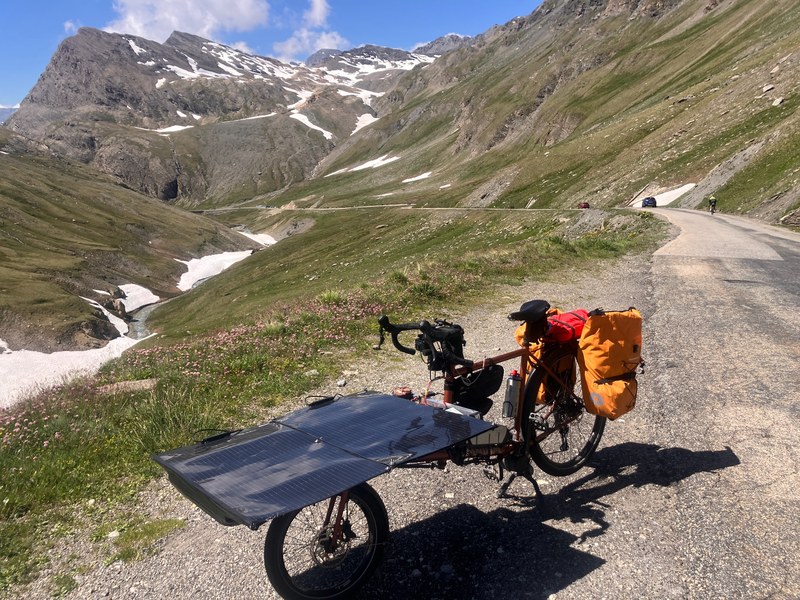
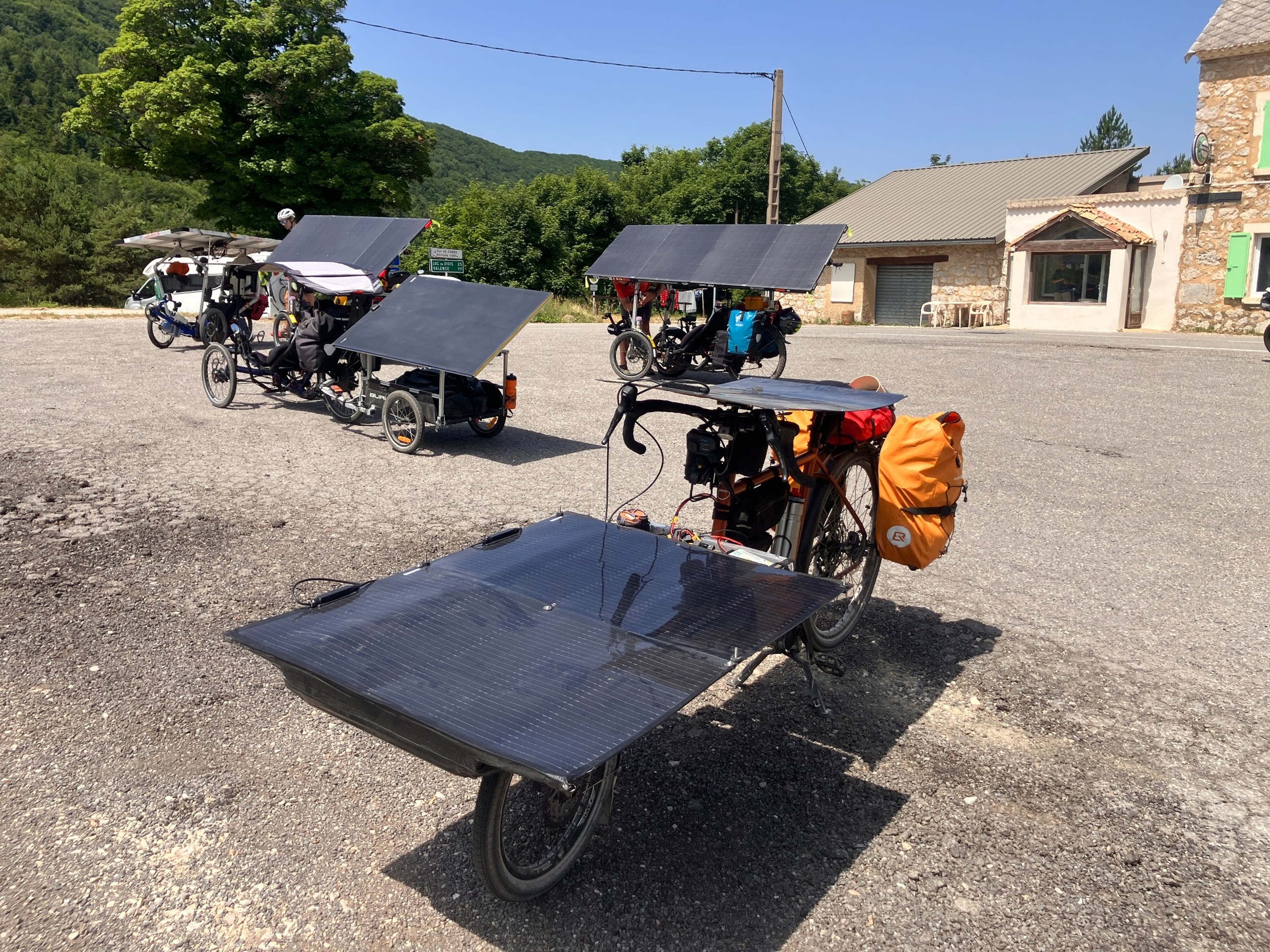
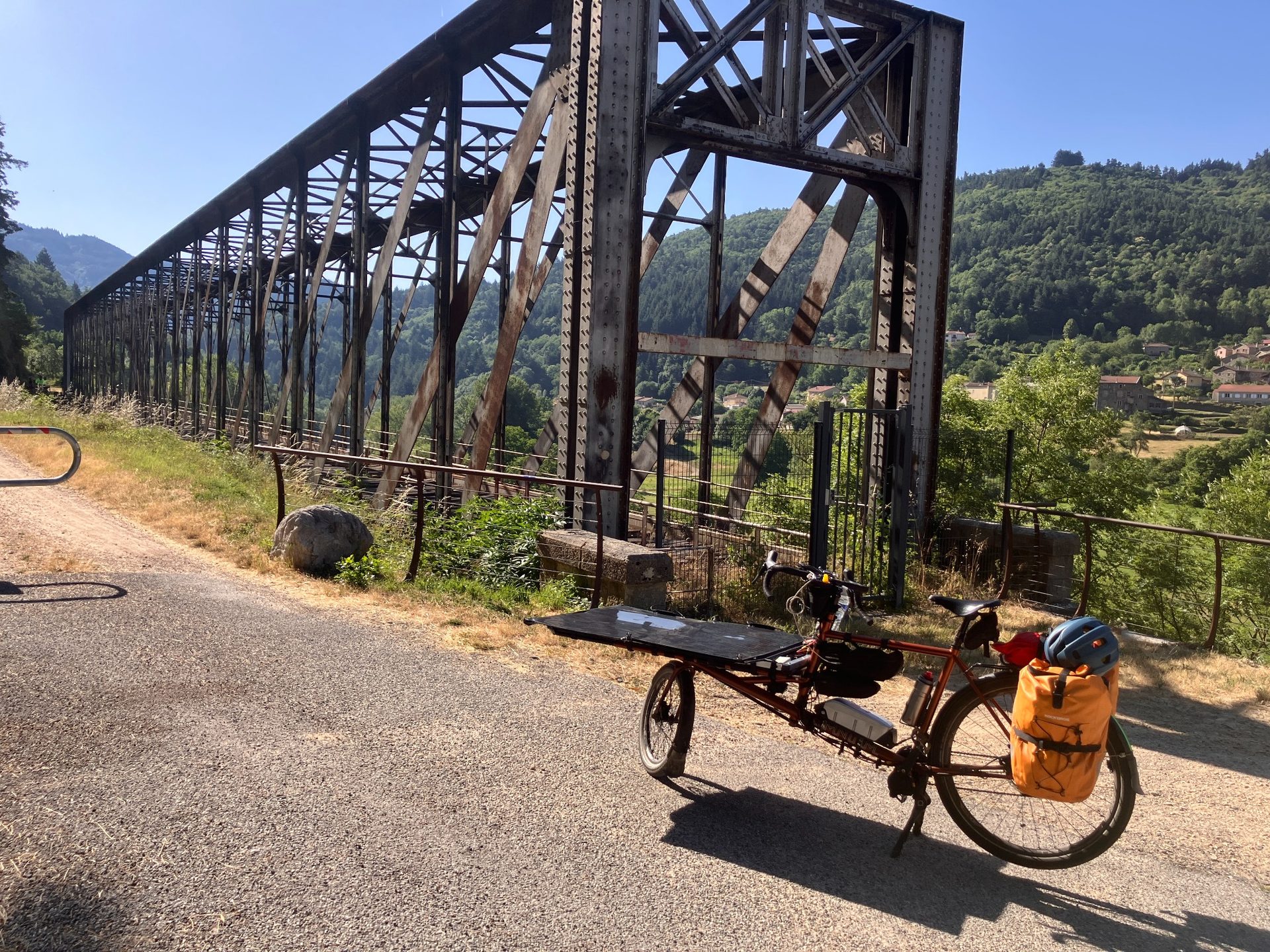
I completed the Sun Trip Alps on an Omnium cargo bike converted into a solar e-bike.
It was remarkably simple.
A production cargo-bike frame. One 250-watt mid-drive motor. Batteries. Solar panels. Luggage.
It wasn’t fast.
It wasn’t aerodynamic.
But it worked.
And perhaps most importantly, somebody looking at it could reasonably think: I could build that.
That was part of the attraction for me. Solar-powered long-distance travel that didn’t require an exotic prototype or an enormous engineering budget. It could be assembled from relatively ordinary components.
Now I’m considering riding towards China.
Naturally, I’ve started thinking about making the bike better.
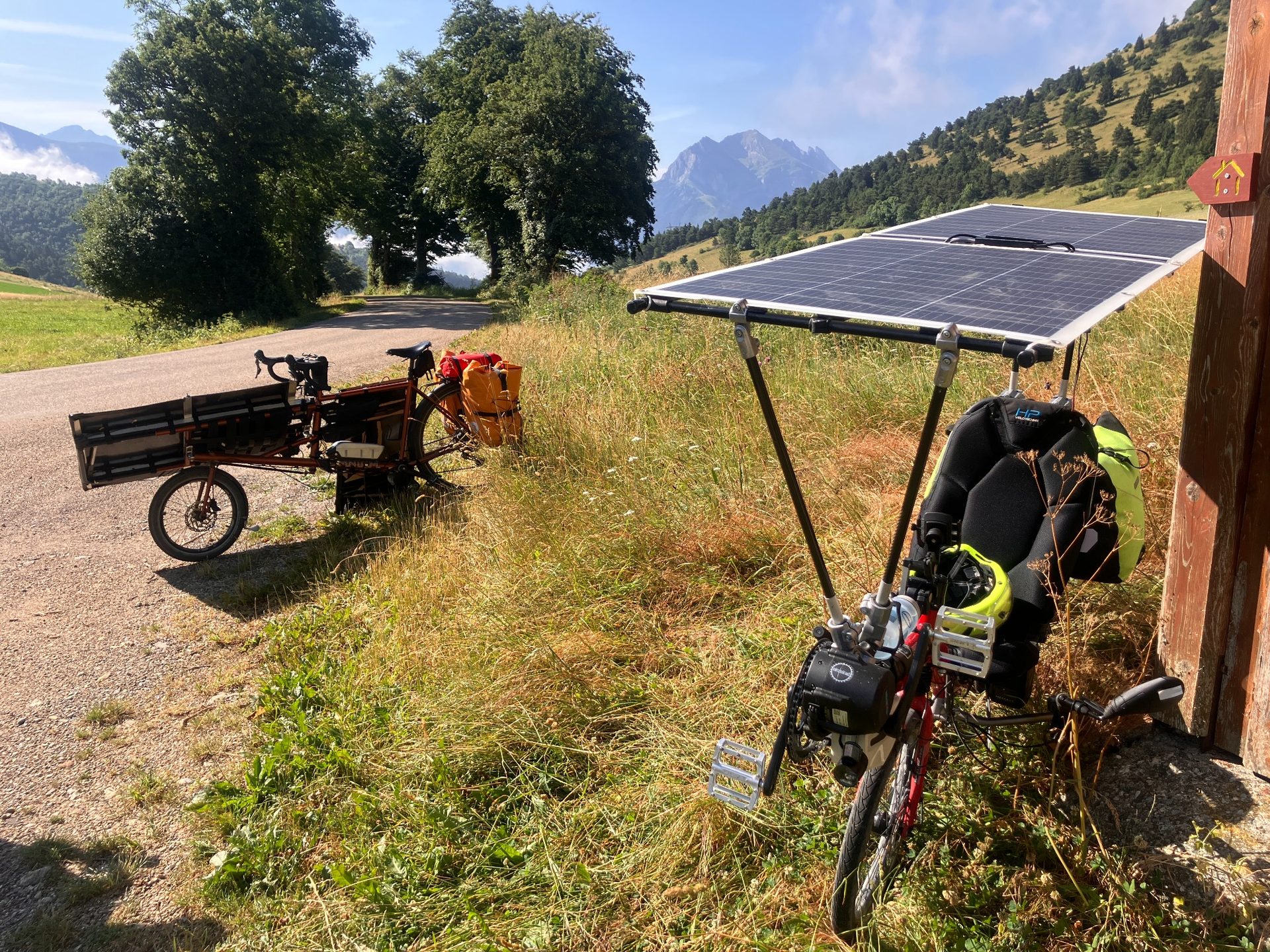
The cycling equivalent of an expedition truck
A recumbent riding position should reduce aerodynamic drag. More solar panels should provide more energy.
A second motor could provide regenerative braking and another option on difficult climbs.
A fairing could improve airflow. A larger battery provides greater security. A tapered tail could reduce turbulence. Better electronics could manage all of it.
Every individual decision has a rational engineering justification.
And yet I’ve started asking myself:
At what point am I building the cycling equivalent of the enormous expedition truck?
My existing cargo bike is perhaps the equivalent of the ordinary reliable van.
It isn’t going to outperform a purpose-built expedition machine.
It isn’t going to win many engineering competitions.
But it should get there.
And perhaps getting there with less is actually the more interesting achievement.
Efficiency isn’t necessarily simplicity
This doesn’t mean abandoning engineering.
A recumbent bicycle may consume dramatically less energy at 25 or 30 km/h than an upright cargo bike.
If testing demonstrates that, changing the riding position could be one of the most sensible modifications I could make.
The same applies to regenerative braking, aerodynamics or additional solar capacity.
The answer isn’t deliberately using inferior technology.
It’s testing whether each additional technology actually earns its place.So before rebuilding the Omnium, there is a much simpler experiment I can conduct.
Buy an inexpensive second-hand recumbent.
Fit comparable electrical assistance.
Ride the same routes.Measure the electrical energy required to maintain 20, 25 and 30 km/h.
Then compare it with the cargo bike.
No solar panels. No theory. No assumptions.
Just measure it.
If the difference is enormous, perhaps the recumbent earns its place.
If it’s marginal, perhaps I’ve just saved myself months of fabrication.
The same test can apply to everything else.
Does the fairing actually reduce Wh/km?Does regenerative braking recover enough energy during real expedition riding to justify another motor, controller and several kilograms of equipment?
Does a bigger battery provide more useful range than its additional weight costs?
Instead of asking:
Can I add this?ask: Does this earn its place on the bicycle?
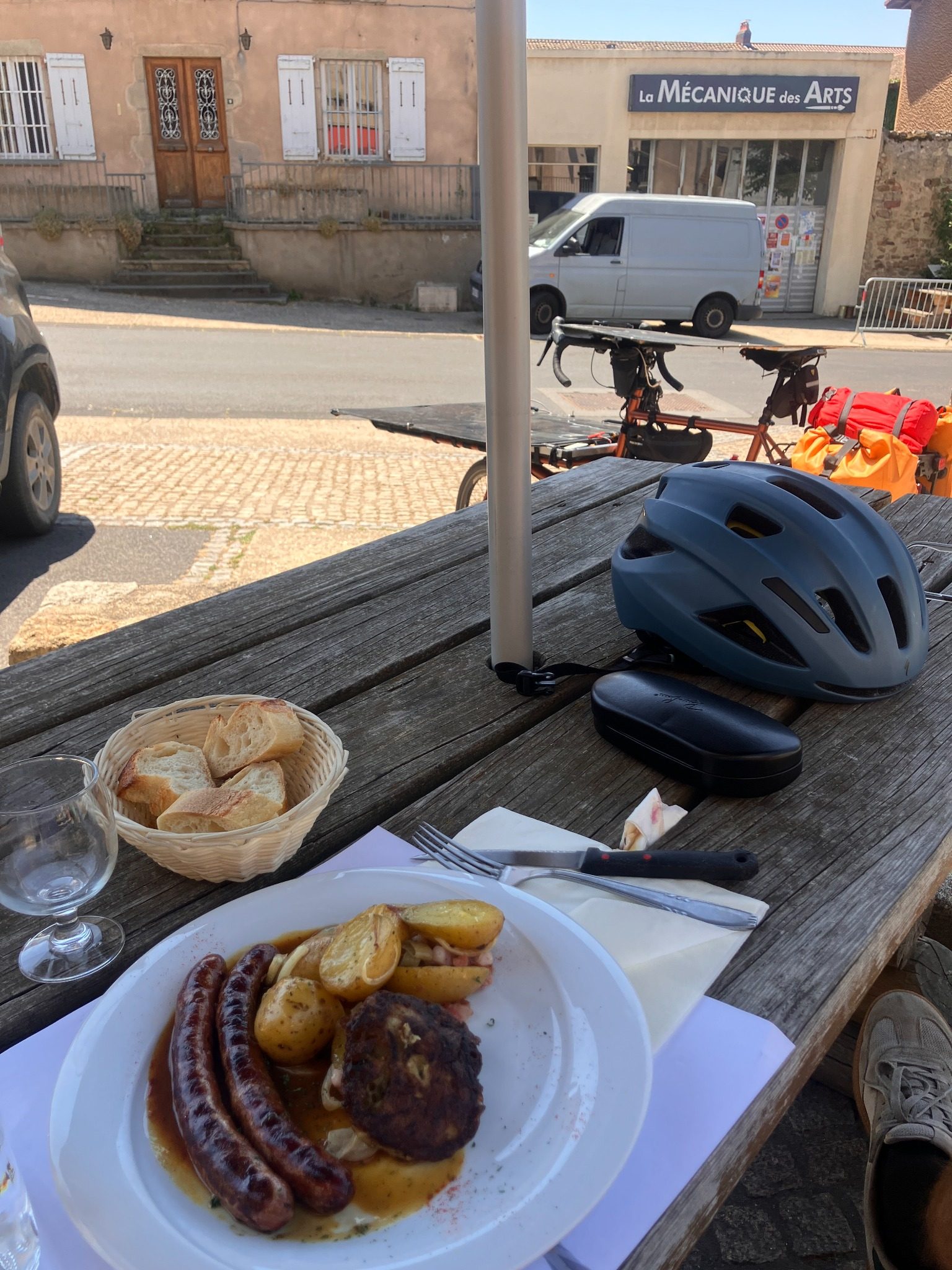
What happens if my own adventure fails?
There is another question I should probably answer before leaving.
Imagine I’ve spent two years building the bike. I’ve documented everything online.
Thousands of people are following the journey.
I’m 7,000 kilometres from home and somebody drives over the bicycle while it’s parked.
It’s destroyed. Without an audience, the calculation might be simple.
Can I afford another one? No.Then the expedition is over.
But with 100,000 followers, another possibility suddenly exists.If only five per cent contributed £1, there would be £5,000 available almost immediately.
Nothing about my physical situation has changed.
I’m still standing beside a destroyed bicycle thousands of kilometres from home.
The thing that has changed is the existence of the audience.
Would I start a crowdfunding appeal?I don’t actually know.
But perhaps that’s something I should decide before I leave rather than after disaster strikes.
Because knowing that the option exists could subtly change the risks I’m willing to accept.
Adventure still needs consequences
I don’t think crowdfunding is inherently wrong.
If somebody has followed an expedition for years and genuinely wants to contribute towards keeping it going, they’re perfectly entitled to do so.
Nor do I believe adventure should become some puritanical exercise where accepting help constitutes failure. Quite the opposite.
Some of the greatest experiences in long-distance travel come from strangers helping each other.Someone gives you somewhere to sleep. A mechanic repairs something for nothing.
A family feeds you.
Another traveller carries a part across a border.
Human generosity is one of the reasons people travel.
But perhaps there’s a distinction between accepting generosity and building an adventure whose financial resilience ultimately depends upon an audience.
Freedom and responsibility have always existed together.
If we want the freedom to choose unusual risks, perhaps part of that freedom is accepting that occasionally the gamble fails.
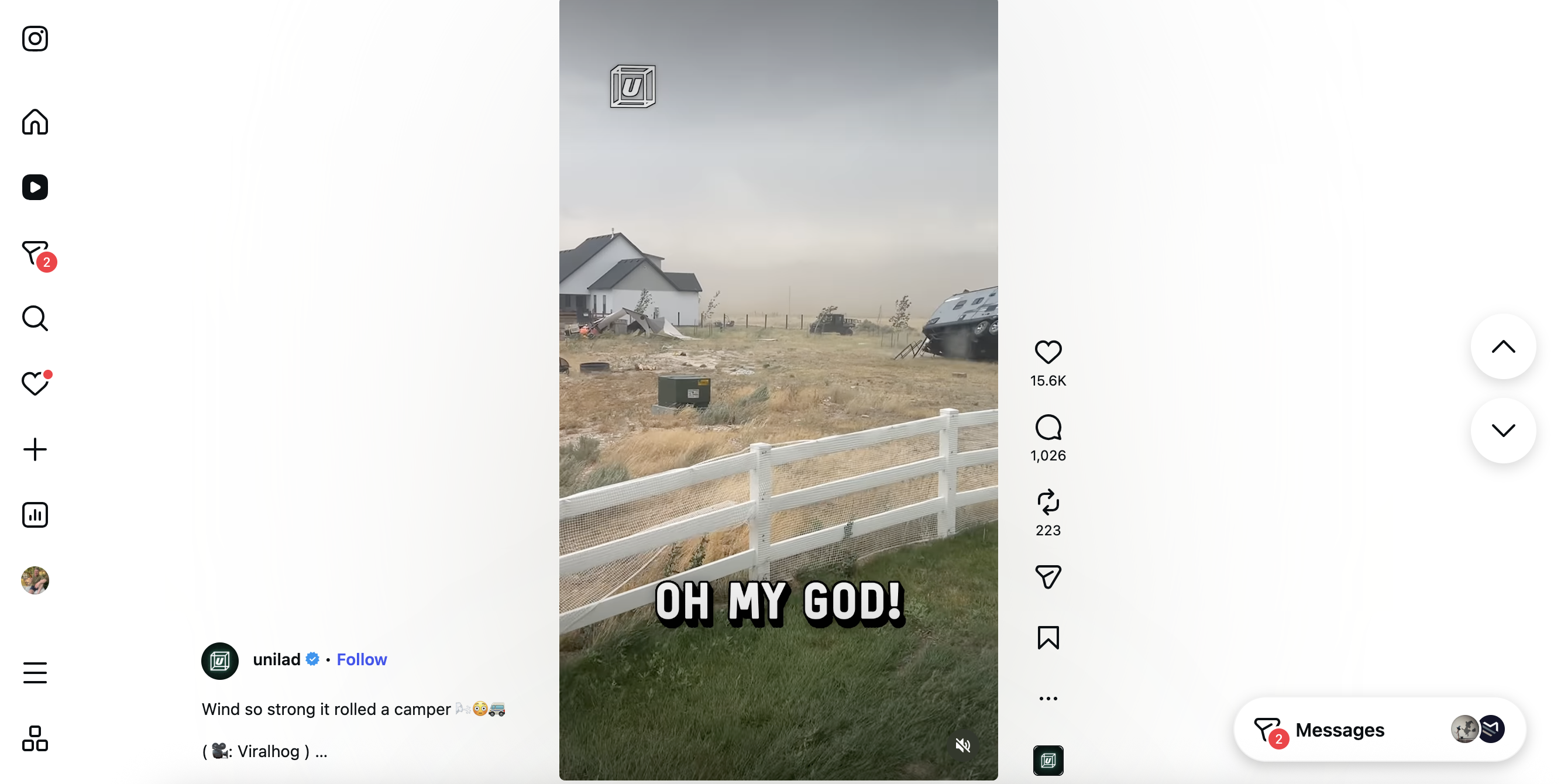
The minimum viable expedition
This brings me back to the solar bike.
Perhaps I’ve been asking the wrong question.
Instead of: What is the ultimate solar bicycle I could build?perhaps the question should be: What is the minimum viable solar expedition vehicle capable of getting me to China?
How inexpensive can it remain? How repairable? How much can use ordinary bicycle components? How little energy can it consume? How much complexity can I remove? And can somebody else look at it and still think:I could build that.
There will always be a faster solar bike.
There will always be a bigger battery, another motor, a lighter composite, another controller or a more aerodynamic shape.
Likewise, there will always be a larger expedition truck capable of crossing terrain that an ordinary van cannot.
But most of the time, perhaps we don’t need the ultimate machine.
We need the machine that’s good enough.
Social media makes it extraordinarily easy to celebrate bigger adventures, more extreme equipment and greater risks.
Perhaps one of the more interesting experiments is to travel in the opposite direction.
Not to discover how much technology, money and risk an adventure can support, but how little it actually requires.

Maybe the point is to go somewhere
Perhaps the final question isn’t really about trucks or solar bicycles.
It’s about what we think adventure is supposed to look like.
Social media constantly shows us bigger journeys, more expensive vehicles, more remote destinations and increasingly elaborate equipment.
We follow people doing these things partly because they’re interesting, but perhaps also because some part of us wants that life too.
We live a little of the adventure through them.
There’s nothing wrong with that.
Inspiration matters. Seeing somebody cross a continent can be the thing that makes another person finally go somewhere themselves.
But perhaps there is a danger in becoming too invested in somebody else’s version of adventure.
Their truck becomes the truck we imagine we need.
Their route becomes the journey worth doing.
Their equipment becomes the standard.
Their dream starts quietly replacing our own.
And meanwhile, an adventure might be sitting much closer to home.
It might be riding somewhere you’ve never ridden before.
Sleeping outside for a night.
Taking an ordinary bicycle across the country.
Getting on a train with a tent and cycling home.
Building something inexpensive and seeing whether it works.
Going somewhere without turning it into content at all.
Perhaps the lesson isn’t that enormous expedition trucks are wrong, or that complicated solar bicycles are wrong.
It’s simply that we probably need far less technology, money and equipment to have an adventure than social media encourages us to believe.
That applies to my own project too.If I eventually ride towards China, I want to remember that the purpose isn’t to build the most impressive solar bicycle on the internet.
The bicycle is only the tool. The point is to go somewhere, meet people, solve problems, see what happens and come back having learned something
.And perhaps we should occasionally spend a little less time watching other people live extraordinary lives through a screen.
Then take whatever bike, van, train, pair of boots or cheap bit of camping equipment we already have and go and have a small adventure of our own.


